Research

News Center Maine reports on UMaine using eDNA to track rainbow smelt

News Center Maine featured research from the University of Maine that tracks down sea run rainbow smelt using environmental DNA, or eDNA. “It runs right up against forensics, it’s just, we move outside of crime scenes and into the wild. The nice things about environmental DNA is it only requires somebody to collect a water […]

Read more
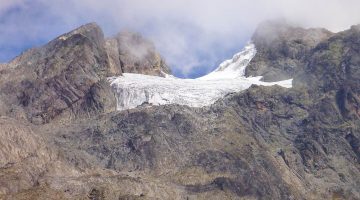
A photo of a mountain glacier

UMaine leads study of Ugandan glaciers that unravels 20,000-year-old geological mystery

Ancient geological discrepancies can not only puzzle scientists, but can also lead to revelations about our present climate once they are solved. An international team led by a University of Maine researcher has uncovered a 20,000-year-old geological mystery in Uganda that will inform how scientists understand the relationship between glaciers, sea level temperatures and precipitation […]

Read more

UMaine researcher explores issues with blood pressure measurement in the dental office

In recent years, health care professionals and patients have become concerned that blood pressure, as traditionally measured in the medical clinic, is not done correctly. That includes blood pressure measurement in a dental office, where it is equally important that it be done correctly, according to University of Maine researchers. Merrill Elias, UMaine emeritus professor […]

Read more

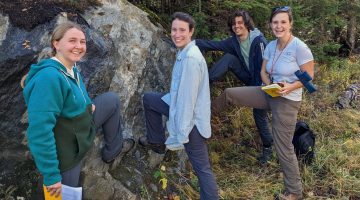
A photo of researchers standing outside next to a large rock

Cruz-Uribe receives NSF award to make geological dating methods more accessible

Editor’s note: Updated Feb. 2, 2023. Geologists have long determined the age of rocks and minerals by measuring the decay of certain isotopes, but the process can be time consuming and labor intensive. Alicia Cruz-Uribe, associate professor of mineralogy and petrology in the School of Earth and Climate Sciences at the University of Maine, is […]

Read more

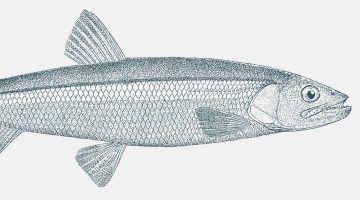
An illustration of a rainbow smelt

UMaine-led study finds that eDNA can help detect rainbow smelt 

Searun Rainbow smelt — a culturally and ecologically valuable fish for New England anglers, consumers and marine ecosystems — is on the decline. Determining the extent of that decline, however, is difficult in Maine. Searun smelt can be easy to miss because they only enter coastal spawning streams from deeper waters during a few cold, […]

Read more

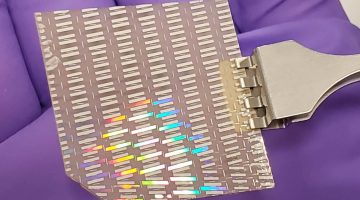
A photo of wireless sensor

UMaine researchers developing new wireless sensors for nuclear facilities 

Developing new wireless sensors for monitoring the functionality of nuclear power plant equipment is the goal of a new project within the University of Maine’s Frontier Institute for Research in Sensor Technologies (FIRST). The U.S. Nuclear Regulatory Commission awarded $500,000 for creating and testing sensors that can withstand the high temperatures and harsh environments in […]

Read more

UMaine Space announces new seed grant awardees

The UMaine Space Initiative is pleased to announce recipients of a new seed grant program created to encourage innovative and interdisciplinary collaborations that result in rapid planning, team development, and research coordination in supported topical areas.  UMaine Space administers an Ideas Lab program for the state of Maine, funded by the National Aeronautics and Space […]

Read more

BDN shares Golet research about Atlantic bluefin tuna

The Bangor Daily News reported on a University of Maine study that aims to quantify the number of giant Atlantic bluefin tuna in New England that die after being caught and released led by Walt Golet, a University of Maine assistant professor of marine science. The U.S. Department of Commerce awarded Golet more than $210,800 […]

Read more